More Details Ãâ» Adams Familymecha John Lyman Center for the Performing Arts
| Willis R. Whitney | |
|---|---|
 Whitney equally a MIT faculty fellow member | |
| Built-in | Baronial 11, 1868 Jamestown, New York |
| Died | January 9, 1958(1958-01-09) (aged 89) Schenectady, New York |
| Nationality | United States |
| Known for | General Electrical Company |
| Spouse(southward) | Evelyn Jones Whitney |
| Children | Evelyn Van Alstyne Schermerhorn |
| Awards | Willard Gibbs Honour (1916) Perkin Medal (1921) IEEE Edison Medal (1934) Public Welfare Medal (1937) John Fritz Medal (1943) IRI Medal (1946) |
| Scientific career | |
| Fields | chemistry, inorganic chemistry, electrochemistry |
Willis Rodney Whitney (August 22, 1868 – January ix, 1958) was an American chemist and founder of the research laboratory of the General Electric Company. He is known equally the "father of industrial research" in the United states of america for blending the worlds of research and industry together; which at the time, were two very singled-out careers.[1] He is also known for his corrosion theory of iron which he developed after studying at Chiliad.I.T. and the University of Leipzig.[1] Whitney was also a professor at M.I.T. for some time earlier his career transition into research directing. He received many awards, including the Willard Gibbs medal, the Franklin medal, the Perkin medal, the Edison medal, the John Fritz medal, the Chandler medal, and many others.[2] He was an astute laic in researching and experimenting for pleasure and voiced his belief at various science conferences.[3]
Personal life [edit]
Whitney was built-in in Jamestown, New York, the son of John Jay Whitney and Agnes (nee Reynolds) Whitney. He had a sister named Caroline Whitney Barrett. Whitney was curious from the very start. He would wonder why things were the way that they were and often performed various experiments at abode. Notably, he wondered why bark grew stronger on one side of trees, what pigeon talons looked like compared to chicken talons, and how things looked like at a microscopic calibration. His marvel of the microscopic was driven by a free YMCA course he attended with his friends.[ane] The class taught by William C.J. Hall, a millowner in Jamestown, showed the boys how to ready specimens and utilise an optical microscope.
Whitney also learned from his father, a article of furniture maker and business organization owner, how to make and employ a ledger. He and his friends started a junk-collecting business organisation, going around boondocks collecting scraps.[1] They would wait until the market price rose for scrap and and then sell them for a profit. Whitney and his friends eventually invested in bicycles with their saved allowances to maximize their business'due south reach. He would too often piece of work for his father in his father'due south factory.
Whitney attended Jamestown Gratis School every bit a immature boy.[three] One day, he met Evelyn Jones on their way to course. She had lost a nickel in the tall grass and was crying that she could non observe it. Whitney stopped and helped her find information technology. Gradually the ii spent more and more fourth dimension together. Whitney decided that he would go a bicycle to go on rides with her; withal the bicycle cost nearly the aforementioned as a microscope he had hoped to become. He ended up getting the microscope first and then the wheel. Eventually the two became husband and wife. They had a daughter named Evelyn "Ennin" (nee Whitney) Van Alstyne Schermerhorn.[1] She was born on May 13, 1892.
As a child, Whitney was Presbyterian and very religious.[three] His formal religion started to fade as he read the likes of Mark Twain, but he kept his organized religion until his death.[3] He would teach Sunday school in Boston'southward Chinatown during his time every bit a student at Grand.I.T.[1]
Whitney's male parent died in his sleep after several months of being ill. Upon hearing the news, he returned from an American Chemical Order conference in California and went to comfort his mother, who was slowly going blind.[i] Attending the funeral, he constitute his mother very calm and serene after she completely lost her sight. Whitney began visiting her more often, until she passed abroad in 1927.[4]
Whitney got to meet the likes of Madame Curie, Thomas Edison, Robert Millikan, and Arthur Compton when he was invited to a luncheon honoring Marie Curie at the Carnegie Mansion.[one] Soon afterwards this, he met J.J. Thomson on a trip to Cambridge Academy in Europe and also got to see Madame Curie'southward laboratory.[one]
As he retired, Whitney spent more fourth dimension on his hobbies: bicycling, his various experiments, collecting arrowheads, and learning such as studying neurology and welding for fun.[3]
During the depression years starting in 1929, Whitney battled a personal depression brought on past always-increasing pressure to defend his laboratory. He had to allow become of many of his workers and was devastated that he could non help them.[1] Businesses were debating whether a research budget was really a cool insurance or an unnecessary luxury. The integrity of the G.E. Research laboratory every bit a scientific establishment was challenged.[3] Whitney took a vacation to recover. During his vacation time, he did some manual labor around his habitation, visited Florida, visited the Grimaldi Caves, visited Nassau, and learned that when living conches are scarred, a pearl-like lime substance will fill in the scarred expanse.[ane] When he returned, he stepped downwards from his position every bit the director of the G.E. laboratory, naming Coolidge every bit his successor.[1] He was diagnosed with psychomotor acceleration effectually this time.[3] He recovered and relapsed through it until his peaceful decease in a hospital. He lived until the historic period of 89. He rests in Mausoleum Lot: Department D Grave Crypt: 38 in Park View Cemetery in Schenectady.[4]
Teaching [edit]
K.I.T. [edit]
Whitney initially wanted to study biology and by take chances visited M.I.T. on the same day that entrance examinations were being administered. He was curious well-nigh the questions and got permission to take the exam that day. He passed without whatsoever grooming.[ane] He would later choose MIT to be his academic institution on account of its laboratories. Whitney was a difficult-working educatee but he was fearful of having a express scope of noesis. He was a special student in that he had not decided on a major. For advice he went to General Francis Amasa Walker, so president of Grand.I.T., who offered that Whitney should avert electrical applied science, and then a relatively new field at G.I.T., and stick to chemistry or biology.[3] Whitney discussed his ideas with his peers, Pierre du Pont and George Hale. He ultimately decided on chemistry.
During his sophomore yr at M.I.T. Whitney met Arthur A. Noyes, a laboratory banana in the chemical science section who inspired Whitney with his piece of work on solutions.[1]
Shortly before his graduation from K.I.T. in 1890, Whitney was appointed as Banana Instructor of Chemistry for the following bookish yr. Information technology was during this time that he met Gerard Swope and William (Bill) D. Coolidge. He also taught Alfred P. Sloan, Paul Litchfield, and Irénée du Pont. He taught full general chemistry for 2 years and then fabricated the switch over to belittling chemical science. He lectured without notes and got to know the individual pupil. Whitney saw students as cognition-seekers rather than storage containers of answers.[three] Similar to his senior, Arthur A. Noyes, Whitney'due south arroyo was more research based. He would give students a problem that was not in their textbook and told them to solve it past researching, devising a method, carrying it out, and by presenting a report. This clashed with the institution's approach. After 2 more years of teaching belittling chemistry, Whitney decided to get to the University of Leipzig to obtain his doctorate and study under Wilhelm Ostwald.
University of Leipzig [edit]
Studying under Wilhem Ostwald, who too taught Whitney's predecessor, Arthur A. Noyes, Whitney's thesis project was on color changes during chemical reactions. He as well accepted the job of translating Max Le Blanc'south Electrochemistry textbook. Le Blanc was a colleague of Ostwald who Whitney met in Leipzig. In 1896, Whitney finished the translation, finished his laboratory work, and successfully defended his thesis. He earned his doctoral degree and went from assistant instructor of chemistry to doctor of philosophy.[3] Later attaining his doctoral degree, Whitney did not leave Federal republic of germany to return home immediately. Instead, he studied organic chemistry with Charles Friedel at the Sorbonne in France for about six months.[1]
Corrosion Theory [edit]
Afterward returning from Leipzig with his doctorate, Whitney resumed working with Noyes in the laboratory. Whitney was intrigued by the competing theories of corrosion during his contempo consulting assignment at a Boston infirmary where rust plagued the h2o pipes.[3] He designed an experiment to come across whether carbonic acid, which was widely accustomed to be necessary for rusting to occur, was actually necessary. To exercise this, he examined corrosion through a physical chemistry approach. He reasoned that corrosion must occur in an oxidation-reduction reaction, like to how Nernst explained the concrete chemistry of a battery.[three] His experiment and then consisted of eliminating all traces of air, acid, and soluble alkali from sealed water bottles. He placed pieces of iron in the water bottles and sealed them with paraffin. So he left the bottles on a shelf and checked to run across if whatever rust had formed each 24-hour interval. Seeing as no rust formed for weeks, he decided to open them and let air in. Near immediately, the water turned yellow and so rust started forming. Whitney reasoned that iron would not have dissolved between the time he opened the canteen and the formation of rust occurred. Thus, he reasoned that the atomic number 26 dissolved into the water before he opened it, due to the hydrogen ion concentration.[1] To verify his results, he sent his undergraduate students to get together more research. Based on Whitney'southward theory, hydrogen ions would exist nowadays during this process; one Whitney student verified this by opening up a rusty radiator and lighting a lucifer.[iii] Hydrogen was present. Basically, Whitney found that the proper electrical contact between the cathode and anodic region besides as the presence of hydrogen ions were enough to make corrosion occur. He besides plant that keeping iron in an alkali solution could forbid rusting. He published his results in 1903 and earned immediate recognition in the American audience. However, Wilhelm Palmaer, one of Arrhenius's students in Sweden, published a similar article in 1901.[iii] While Whitney can not exist credited for discovering corrosion theory, he did introduce it to the masses.
Eastman Kodak [edit]
George Eastman from Eastman Kodak came to K.I.T. one day, to enlist Arthur Noyes and Whitney'south help. In merging with the American Aristotype company, Eastman needed help to lower costs by making the production of photographic newspaper less wasteful. Specifically, Eastman saw the need to recover the booze and ether vapor that was going to waste in the photographic paper product process.[ane] After some weeks, Noyes and Whitney had found a solution. Although the exact details of the solvent recovery process remained as secret, the procedure appeared to take involved collecting the evolved vapors and distilling them back into their constituents after passing them through a sure chemical gel.[3] In July 1899, Noyes and Whitney signed a contract that granted the company total use of the procedure while paying the two chemists a handsome sum of coin, funding half of a laboratory, and giving the two chemists stock from said company.[3] At the fourth dimension, this crossover betwixt academics and businessmen was uncommon.
General Electrical [edit]
In 1900, Whitney received correspondence from Edwin W. Rice and Elihu Thomson of General Electric. They wanted Whitney to become the director of General Electric'due south new Electrical Enquiry Laboratory. Whitney blatantly turned down the offering multiples times on account of his love for didactics. Finally, Rice proposed that Whitney could come up try performing experiments without any commitment and he could travel between M.I.T. until he chose either. Whitney took this offering and met Charles Steinmetz on ane of his first days there. Steinmetz had been working in his own private laboratory near the Schenectady lab

William Coolidge, Willis Rodney Whitney, Thomas Edison, Charles Proteus Steinmitz, Irving Langmuir at the G.East. Laboratory. (front end row, left-to-correct) 1923.
for a while. Whitney was eager to produce something that would be beneficial to the company in order to prove his endeavor meaningful.
Electrical Furnace [edit]
One of the showtime bug Whitney solved at the Full general Electric Laboratory was that of making a furnace that produced porcelain rods with scientific precision. He noticed that many rods would go to waste considering of various defects.[1] Afterwards consulting with a foreman, he institute that the electric current furnaces had varying temperatures; especially later a certain amount of repetitions. As a result, the furnaces could not be expected to produce perfect porcelain rods after every endeavor. After experimenting with iron pipes, carbon pipes, and wire, Whitney found that he could create a suitable furnace past passing a controlled amount of current through a wire wrapped around a carbon pipe.[iii] The carbon pipe would take a cork or coal powder in information technology to forestall combustion and water-cooled clamps to regulate the temperature. After finding the perfect ratio of estrus to fourth dimension cooking the porcelain rods, Whitney called in the foreman. Whitney demonstrated that the porcelain came out perfectly almost every time and G.E. began production of the furnaces immediately.
Yard.E.Thousand. Lamps [edit]
Later finding success with his electric furnace design, Whitney moved on to tackling the trouble of improving the incandescent lamp. The trouble was that the current carbon filaments in the incandescent lamps evaporated so quickly at loftier temperatures that to lengthen the lifespan of the bulbs, it was just viable to continue them on at lower temperatures, thus less light would exist emitted.[3] Pressure from contest with other companies like Westinghouse made the laboratory's major goal to improve the incandescent lamp for the time.[5] To tackle this problem Whitney recruited the help of some of his erstwhile M.I.T. students and strange scientists. Eventually in December 1903, Whitney institute his solution. He used the electric furnaces from his porcelain experiment to subject the current carbon filaments to carefully controlled yet hotter temperatures.[1] The carbon filaments began to class a graphite layer that had metal-like properties. The resistance of the outer layer of the filament grew with increasing temperature, allowing for the lamp to exist run at hotter temperatures for longer. Using his connection with the G.Eastward. Mill in Harrison, Whitney got his filaments into production as before long equally possible.[3] The lamps that used these filaments were named "Full general Electrical Metallized" lamps or "M.E.Yard." lamps for short. It was shortly after this in May 1904, that Whitney decided to leave M.I.T. and accept the total-time position equally managing director of the General Electric Research Laboratory.
Whitney may have gotten his inspiration for his filaments from the time he visited the Paris laboratory of Henry Moissan, an electrochemist who subjected graphite to enough rut and pressure to believe he made diamonds.[3]
Tungsten Lamps [edit]
The new tantalum filaments created by Werner von Bolton once again pressured the lamp industry.[3] Whitney and his team set to work by investigating the elements near tantalum on the periodic table. They
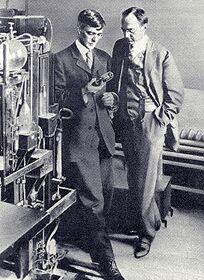
Irving Langmuir (left) and Willis R. Whitney (right) in the G.Due east. Laboratory. 1920
found that tungsten would be the nigh suitable for the job; if not for its brittleness. Afterward recognizing that he needed to recruit some other talented scientist, he enlisted the help of William D. Coolidge, one of his erstwhile chemistry students. He gave Coolidge the same deal that Rice had given him; recognizing that Coolidge, like Whitney himself, did not want to leave his M.I.T. research for an industrial laboratory.[ane] Coolidge eventually became invested in his work on the tungsten filament and solved the trouble using a cadmium amalgam folder to shape the filament. The binder would distil out as the filament was heated, leaving backside a pure tungsten filament. Whitney was sent to Germany to written report incandescent and tungsten lamp work in Frg before long afterwards this discovery. Upon returning he explained to his employees that the Germans had a like procedure that Chiliad.Eastward. bought the patent to, but he insisted that Coolidge's process volition exist better in the long-run if it can be given a petty more than time to be perfected.[1] Effectually Dec 1907, Coolidge reported that the process was perfected and that the filaments could exist sent for mass production. Shortly afterward hearing Coolidge's study, Whitney was hospitalized due to untreated appendicitis.[1] He spent Christmas at that place, but was comforted by his employees who came to visit him.
These tungsten-filament lamps were sold aslope the G.E.M. lamps for a short period of time, until the company dropped the M.Due east.M. lamp altogether for the superior tungsten-filament lamp.
Blackening Bulbs [edit]
After Whitney'southward return to the laboratory afterward recovering from appendicitis, Whitney met Irving Langmuir, a young chemistry professor who came to the G.Eastward. Laboratory to practice research over the summer. Langmuir wondered why the lamp bulbs blackened after use and started working on a solution almost immediately after arriving at the lab. After not having produced tangible results during the summer,
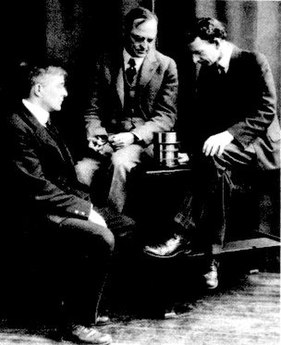
The big three of the G.Eastward. Laboratory. Willis R. Whitney (center) and Irving Langmuir and William Coolidge. 1909
Langmuir was prepared to get out the G.E. Laboratory to avoid wasting funding and time. Whitney insisted that Langmuir stay as long every bit he was having fun; that he would take care of the administrative details. Three years later, the same scenario occurred. In 1913, Langmuir had a breakthrough. He found that by the blackening of the bulbs was caused by the tungsten filament evaporating on to the drinking glass. Simply put, this could be mitigated by introducing a vapor to the bulb and by altering the shape of the filament; the best vapor based on Langmuir's experiments was argon.[three] Argon slowed the evaporation of the tungsten and notwithstanding another revolution was made in the lamp industry. The new lamp, using Coolidge's tungsten procedure and Langmuir'due south gas-filling process was marketed equally the Mazda C Lamp, referencing the Persian god associated with low-cal.[one]
Inductotherm [edit]
Ane twenty-four hours, some of the amateur lab boys walked into Whitney'south role and complained about feeling unwell. They had been working near loftier-frequency equipment all day. Whitney took this with skepticism, but immune the boys to go home early for the 24-hour interval. The next solar day he had Dr. Glen Smith from the nearby hospital conspicuously demonstration with the boys to solve what was going on. Dr. Smith also developed a fever.[1] Whitney ran experiments on cockroaches and mice, artificially increasing their internal temperatures with a loftier-frequency apparatus to get some more data. He somewhen worked his way upwards to experimenting on a diseased dog and the dog was cured with one hr of handling a mean solar day. Whitney recalled Dr. Julius Wagner-Jauregg'south trials with purposely giving patients with brain disorders malarial injections to induce a fever in the hopes of curing them.[i] Before progressing any further with this appliance, he experimented on his cocky and found that information technology relieved his potent shoulder pain. He progressed with his trials to Ellis Infirmary. Then, he moved on to conducting trials at a dispensary at Columbia Presbyterian Medical Center. He later worked with doctors from the Albany Medical Higher to perfect this device.[1] The device operated past using a vacuum tube to create electromagnetic waves every bit long equally a meter or as short as one 10-thousandth of a meter at maximum. Whitney formally wrote a paper regarding the theory of how this device treated bursitis by raising levels of lactic acrid near muscles and transporting calcium bone deposits.[iii] After the paper was published in the Thousand.E. Review, the G.E. 10- Ray corporation branded this device every bit the "Inductotherm" and sold it to the masses.[i] The "Inductotherm" is actually a diathermy device. It was for this that Whitney was later awarded with the French Legion of Honor.[1]
Other Endeavors [edit]
Coolidge also had a breakthrough in 1913 with his hot cathode X-ray tube.[1] Ezekiel Weintraub worked on various projects aslope Coolidge, Whitney, and Langmuir but was especially drawn to wireless telegraphy.[3] Other projects included developing ameliorate electrodes, lightning arresters, insulating materials, carbon motors, generator brushes, soapstone plates, electric blanket, etc.[one] While Whitney did not

Whitney (left) and Langmuir (center) showing Guglielmo Marconi (left) a vacuum tube that G.E. produced for radio transmitters. This is one of the many other experiments that Whitney was not majorly involved in, but nonetheless oversaw the progress of.
work on each project straight, he would often come up up with ideas and offer them to his employees for them to work on.
Research Directing Methods [edit]
As the director of the General Electric Enquiry Laboratory, Whitney had to take care of authoritative details, hire employees, fire employees, read the latest scientific journals, write manufactures on new inventions, attend conferences, speak at conferences, etc. Whitney believed in encouraging collaboration in the laboratory and held mandatory weekly meetings that he chosen colloquia.[one] In these meetings, his researchers were required to update each other on any progress or discoveries, disembalm any issues, offer advice, or simply talk over something they learned somewhere. Whitney made it a indicate to bank check in with every i in the research lab every day to offer advice, encouragement, more often than not inquire, critique, or just say howdy.[1] He believed that this would encourage teamwork and boost morale. Whitney chose his research squad applicants based on those who already had one to two years of experience performing their own experiments besides as based on the private's want to experiment and strong ideas. Considered the founding begetter of industrial research, Whitney came upwardly with three principal ideas for smooth direction.[three]
- All inventions would remain the researcher's work but would go to the company.
- Each individual is allowed to accept a personality. Every bit a research director, Whitney wanted his employees to play to their strengths.
- A research manager should remain optimistic. Whitney was an astute believer in profiting from seemingly aimless research.
As time got harder, the Full general Electrical Laboratory focused more on curt-term goals in order to maintain profit. However, they still had one or two major projects standing at all times. When the stock market crashed in 1929, Whitney had to burn down many of his employees.[1] This plunged him into a depression that he took a half dozen month holiday to remedy. Coolidge remained acting director ever since and eventually, in 1932, Whitney announced his programme to retire and effectively make Coolidge the next managing director. During Whitney'due south time, the G.E. Laboratory effectively combined the worlds of industry and research and became known as the "Business firm of Magic."[three]
Patents [edit]
While working at 1000.East., Whitney filed many patents. He besides encouraged his employees to write downwards anything in their laboratory notebooks as they could use this as evidence in patent suits in the time to come.[iii] In add-on, based on company policy, patent idea letters had to addressed to Whitney, who would then decide whether the idea could be profitable.[iii] Then, Whitney would relay the idea to the company's patent section. Among the patents that Whitney filed as an inventor are...
- A vapor electric device and operation method: United states 2307052, Gordon & Whitney, "Vapor Electric Device and Method of Operation", issued 1943-01-05
- An improvement on the previously mentioned device: United states 2347048, Gordon & Whitney, "Vapor Electric Device and Method of Operation", issued 1944-04-18
- A refrigerant control device: United states 2548643, Whitney, "Refrigerant Flow Controlling Device", issued 1951-04-10
- A moisture indicator: United states 2021760, Whitney, "Moisture Indicator", issued 1935-11-19
- A water-purification apparatus: US 2340721, Whitney, "Apparatus and Method for Purifying H2o", issued 1944-02-01
- A soot disposal apparatus and its operation method: Us 1828631, Whitney, "Soot Disposal Process and Apparatus", issued 1931-10-20
- A photoelectric system: US 1794222, Whitney, "Photoelectric Organization", issued 1931-02-24
- A method of making crucibles: Us 1784647, Whitney, "Method of Making Crucibles", issued 1930-12-09
- A composite metal gear: US 1685657, Whitney, "Composite Metallic Article", issued 1928-09-25
- A process of producing a matte finish: U.s., Whitney, "Process of Producing Matte Finish", issued 1925-12-15
These are just a few of the many patents Whitney filed. Whitney'south connections with 1000.E.'s patent section helped expedite the patent awarding process for any new inventions or discoveries the inquiry laboratory may have found.
[edit]
When Josephus Daniels organized a Naval Consulting Board during World War I, Whitney was recruited to be on information technology.[1] Led by Thomas A. Edison, the purpose of the board was to field ideas and run across which ones were feasible. Whitney was appointed chairman of the chemistry and physics divisions and was presently put in charge of enquiry of all nitrate production at Muscle Shoals on the Tennessee River.[1] Using his connections at G.Eastward. and Du Pont, he got an experimental submarine detection station built in Nahant, Massachusetts. While Whitney was in accuse of the inquiry, Irving Langmuir, who was also recruited, led the Nahant station, and Coolidge experimented with rubber tubing at that place.[1] During this time, Whitney recruited Albert Hull from Worcester Polytechnic Found to work with him at G.E. and on this project at Nahant. Eventually Coolidge developed his C-tube, a condom tube with a piece of metal fastened, that could discover submarines up to 2 miles away.[one] Dr. Hull and colleagues somewhen improved on this design to make the Chiliad-tube that could observe submarines up to ten miles away.[one]
Philosophy [edit]
Whitney was a proponent of researching and experimenting for pleasure. He disliked authoritative details; before existence pressured by the visitor, his weekly "colloquia" were informal and coincidental.[3] He would often ask his employees whether they were having fun as he firmly believed in "serendipity." After reading Horace Walpole's version of The Three Princes of Serendip, he often tried to teach his employees to follow such a practice.[1] Guys Suits recalls Whitney saying, "Necessity is not the mother of invention. Noesis and experiment are its parents."[6] Here are some other of his notable sayings:
"Never label an experiment useless; it may reveal something unthought of but worth knowing."
—Willis R. Whitney, in Virginia Veeder Westervelt, The World was his Laboratory; The Story of Dr. Willis R. Whitney
"Discoveries and inventions are not terminals; they are fresh starting points from which we tin can climb to new knowledge."
—Willis R. Whitney, in Virginia Veeder Westervelt, The World was his Laboratory; The Story of Dr. Willis R. Whitney
Whitney wrote several articles, gave speeches at science conferences, and argued in favor of increasing interest in research. This was i of his critiques upon returning from Leipzig. Whitney believed that chemists should do research; estimating that but a small percentage of those with degrees in chemical sciences in the United States actually did any chemical inquiry.[3] Upon meeting with Marie Curie at the Carnegie mansion, Whitney put his efforts backside setting up funding for interested future scientists.[three] He helped establish the Gerard Swope Loan Fund for Thou.Eastward. employees and the Steinmetz Memorial Scholarship.[iii] In improver, the G.E. laboratory implemented a "test" program where college students would work there as "test" assistants and attend college at dark.[one]
Various Experiments and Hobbies [edit]
In addition to Whitney's career-related experiments, he also conducted many of his own experiments for pleasance. Hither are some notable ones:
Turtle Tracking [edit]
Beginning around 1912, Whitney focused more of his energy towards one of his favorite hobbies: turtle tracking.[three] He would log his encounters, locations, dates, and fifty-fifty mark the turtles' shells to track them. Once he witnessed a turtle laying its eggs and marked the spot. A skunk came along and ate some eggs, so Whitney scared it off before information technology could eat all of them. Then, when hatching flavor came, he and his wife came downwardly and watched the turtles hatch.[1] Somewhen Whitney began to keep some in captivity, simply he noticed that turtles will non lay eggs in captivity. While conducting his various turtle observations in Niskayuna Woods, Whitney constitute that turtles liked to swallow bananas, they migrated annually to aforementioned spot each year, and that their age could be told past rings on their shells.[three] He also found that turtles would bury themselves in mud in the fall, get snowed on in the winter, and emerge live in the leap.[6] During the Neat Depression in the 1930s, Whitney would give children who brought him a turtle a quarter.[3]
Vacuum Fly Experiment [edit]
At one point, Whitney received a letter request whether insects could survive in a vacuum.[half dozen] Whitney gave this experiment to an employee to perform, but the employee replied that it was pointless. Some other employee was offered the experiment to the aforementioned result. Whitney somewhen performed the experiment himself. He sealed a cockroach and a fly in a vacuum chamber and observed. The insects stopped moving. After some time, Whitney gradually released the vacuum and both insects started moving again.[half dozen]
Freezing of H2o [edit]
Whitney was adequately active in keeping up with scientific journals. Once, he entered the discourse regarding the freezing of hot and cold water later on reading an commodity in the periodical Science, titled "Roger Bacon Was Mistaken."[7] Whitney performed the experiment himself after some reasoning based on colligative properties. He decided that considering heating water commonly dispels any soluble components, the hot h2o'south freezing point should exist raised compared to the colder water'southward. Thus, the hot water should freeze faster. Performing the experiment himself, he found that the hot water tray that he left in his freezer froze significantly more than the cold water tray, measured by volume. He published his own article in the same journal in June 1946.[7]
Whitney'due south Crib [edit]
One day, the Whitney's and a babyhood friend'south family went out on Lake Chautauqua over the summer. Whitney noticed that if the camp they were staying at had a seawall, the dock and land would exist protected from any waves. He took information technology upon himself to oversee and facilitate the construction of such a seawall.[1] Some time after, he found a shallow area in the centre of Lake Chautauqua. He got out of his friend'southward boat and inspected it for a couple hours. He dropped stones hither and at that place and the idea to brand an actual island popped into his head. He hired a team and set to piece of work filling the 2-hundred and fifty-six pes space with rocks. The following summertime the island was completed. Whitney erected a flag there and left Whitney's Island. He went down to a courthouse and received a human action to the belongings on November 6, 1899. It was made out to Willis R. Whitney and Fred E. Armitage. The island has been lost to time and is now known as Whitney's Crib to visitors of Lake Chautauqua.[8]
Memberships and Positions [edit]
Whitney held the following positions and was a fellow member of:[2]
- Translator of M. Le Blanc's Electro-Chemistry (1896)
- Member and President of the American Chemical Order (1909)
- Member and President of The American Electrochemical Lodge (1911–1912)
- The U.Due south. Naval Consulting Board (1915)
- The National University of Sciences (Elected 1917)
- The Informational Committee to the National Bureau of Standards (1925-1930)
- Honorary Vice President of G.Eastward. (1932)
- Director of G.E. Inquiry Laboratory (1900-1928)
- Vice President of G.E. in charge of enquiry (1928- 1941)
- The American Institute of Electric Engineers
- The American Institute of Mining and Metallurgical Engineers
- The American Institute of Electrical Engineers
- The American Society for the Advancement of Scientific discipline
- The American Academy of Arts and Sciences
- The American Physical Society
- The American Philosophical Society
- Honorary Member of the American Steel Treaters' Gild
- The French Legion of Honor
- The Franklin Institute
- The British Institute of Metals
- The National Enquiry Council
- Trustee of the Albany Medical College
- Trustee of the Dudley Observatory in Albany
- The Board of Governors of Union College
- Emeritus Member of the Corporation of the Massachusetts Institute of Engineering[9]
- Emeritus Professor of Chemic Research at M.I.T.[9]
- Associate Editor of the Journal of Industrial and Engineering Chemistry
Awards and Titles [edit]
Whitney attained the following awards and titles:[two]
- Willard Gibbs Medal Recipient (1916)
- Honorary Doctor of Science from Union College (1919)
- Honorary Doctor of Chemistry from the University of Pittsburgh (1919)
- Chandler Medal (1920)
- Perkin Medal Recipient (1921)
- Honorary Doctor of Scientific discipline from Syracuse University (1926)
- Honorary Doctor from the Academy of Rochester
- Honorary Degree from the University of Michigan (1927)
- Public Welfare Gold Medal of the National Institute of Social Sciences (1928)
- Honorary Doctor of Laws from Lehigh University (1929)
- Franklin Medal of the Franklin Constitute (1931)
- Edison Medal "for his contributions to electrical scientific discipline, his pioneer inventions, and his inspiring leadership in research" (1935)
- Ornament of Chevalier of the French Legion of Honor (1937)
- Public Welfare Medal from the National Academy of Sciences, (1938)[ten]
- John Fritz Medal Recipient (1943)
- First recipient of the IRI Medal from the Industrial Research Institute (1946)
- Distinguished Service Gold Key from the American Congress of Concrete Therapy
- Walk of Fame Stone at Rollins College[ane]
- Showtime recipient of the Willis Rodney Whitney Award from the National Social club of Corrosion Engineers[1]
References [edit]
- ^ a b c d due east f grand h i j k l thou n o p q r s t u v w 10 y z aa ab ac ad ae af ag ah ai aj ak al am an ao ap aq ar Veeder., Westervelt, Virginia (1964). The world was his laboratory : the story of Dr. Willis R. Whitney. Messner. OCLC 937428836.
- ^ a b c "WHITNEY, Willis Rodney | Marquis Who Was Who in America 1607-1984 - Credo Reference". search.credoreference.com . Retrieved 2021-04-07 .
- ^ a b c d east f g h i j thousand l yard n o p q r southward t u v westward ten y z aa ab ac advertizing ae af ag ah ai Wise, George (1985). Willis R. Whitney, General Electric, and the origins of U.Southward. industrial inquiry. Columbia University Printing. OCLC 1036919994.
- ^ a b "Dr Willis Rodney Whitney (1868-1958) - Discover A..." www.findagrave.com . Retrieved 2021-04-26 .
- ^ "Lighting A Revolution: Willis R. Whitney". americanhistory.si.edu . Retrieved 2021-04-19 .
- ^ a b c d Suits, Guy (1960). Willis Rodney Whitney (PDF). Washington D.C.: National Academy of Sciences.
- ^ a b Casey, Robert S.; Whitney, Willis R. (1940). "Freezing of Hot and Cold Water". Science. 91 (2374): 619. doi:ten.1126/scientific discipline.91.2374.619. ISSN 0036-8075. JSTOR 1667437. PMID 17799535.
- ^ Carlson, Norman P. "Strange Stories of Lake Chautauqua ." McClurg Museum, mcclurgmuseum.org/collection/library/lecture_list/cchs_lecture_strange_stories_by_norm_carlson.pdf.
- ^ a b Letter from Interim President Julius A. Stratton Regarding the Death of Willis R. Whitney, 1958 January xiii, AC0069_195801_015, Box: 6. Massachusetts Found of Technology. Libraries. Department of Distinctive Collections.
- ^ "Public Welfare Medal". www.nasonline.org . Retrieved 2021-04-10 .
External links [edit]
- Willis Rodney Whitney Award of NACE International
- . Encyclopedia Americana. 1920.
Source: https://en.wikipedia.org/wiki/Willis_R._Whitney
0 Response to "More Details Ãâ» Adams Familymecha John Lyman Center for the Performing Arts"
Post a Comment