Fast Way to Upload Media to Server
How to Brand Uploading 10x Faster
Do you feel similar your web awarding could be responding a chip faster? We had the aforementioned feeling so we tried something new…

W hen we've noticed that our app was responding slowly, nosotros tried the usual optimisations. Simply the result wasn't really satisfying. As it turned out, the slowest part of our application was uploading files. But is it even possible to make uploading faster?
How about a brief introduction before nosotros go our hands dirty? If y'all're in a web applications business, you've probably faced some problems with your app non being responsive enough. The clogging is unremarkably caused past 1 of the post-obit:
- Poorly optimised lawmaking
- Servers and clients' devices running slow
- Bad network connexion
The first 1, whether it'southward a legacy server code, not-optimal database queries or some browser-blocking JavaScript, can usually be tracked and stock-still with relative ease (easy every bit "I know what should be done", not necessarily "it'due south a piece of cake").
What if your lawmaking is already top-notch quality, but your servers brainstorm to have trouble serving all the people who use your application? It actually sounds similar quite a expert sign for you and your business concern. You'll probably stop up switching to more powerful servers to handle all the incoming traffic. Or maybe it's but a high latency issue? Then a Content Delivery Network (CDN) might be what you lot need.
Client devices being too deadening is usually a non-consequence in case of nearly web applications, because most whatsoever device capable of running a web browser should provide a decent experience to the user.

We're now left with only one possible cause: poor network connectedness. Thankfully download speeds are getting improve, simply you tin can still make your website load faster with avails minification and compression. Any modern spider web server is capable of serving gzipped files, which allows clients to download less data to see your website (and if you're not gzipping yet, information technology's probably a skillful time to consider doing and then). But what if you desire faster responses the other way around?
Welcome to the Night Grounds of Uploading
What is and so nighttime about it? For starters, if we were to compare download and upload speeds nosotros volition observe out that a lot of people use asymmetric Internet connectedness (no source for this, simply yous're also one of them, aren't you lot?). And the disproportion means upload speeds up to x times slower than download. And then, while 60Mbps connection is corking at all, 6Mbps upload sounds rather slow. This is actually non fifty-fifty 1MB/s.

Moreover, dissimilar servers, browsers have no native way to compress data before uploading. And then here we are, stuck with slower network speeds and bigger files, or… are we?
Nosotros came upward with a simple thought to solve this problem. While nosotros can't strength people to become a faster connection, we can endeavour to send less data — the same way we do it on servers. Simply how can we shrink data in a browser earlier uploading?
Let'south Run across Pako
What is pako? According to the clarification, it'due south a zlib port to javascript, very fast! In other words we've just equipped browsers with a power of gzipping data — this allows the states to plow an thought into a working solution. And using it is nigh a no-brainer. For instance, earlier uploading a file, you would compress it with:
var compressed_file = pako.deflate(input_file); That was easy, wasn't it? But let's stop for a 2d and talk most when yous should actually exercise this.
We Can't Shrink Everything
OK, we can but sometimes it just doesn't make sense. For example, you won't brand images or videos whatsoever smaller with gzip (at least most of them — standard formats like jpg or mpeg are already well compressed).
Text information, on the other side, compresses really well. Depending on a file, we may actually expect upwards to 90% compression ratio. And it's not simply plain text that can be packed that well. In our case it was 3D related files (obj, stl, etc). Perchance you've got some Excel spreadsheets or huge Photoshop files waiting to be uploaded? Get ahead, and try to shrink them showtime. Y'all might be surprised by how much space this can save you.

But Compression is Slow
And then is uploading files. Remember how we've talked almost asymmetric networks? With upload speeds that wearisome, there should exist a point where compression time is considerably shorter than uploading. And it's non actually hard to reach this betoken. For most well-compressable files, you're already in that location. Compressing and uploading smaller file will be faster than uploading uncompressed, bigger data.
But to make sure we don't spend too long compressing, nosotros will employ the everyman compression level (one out of 9). It's the fastest one but withal reduces file size significantly. In most cases you won't gain much with higher levels.
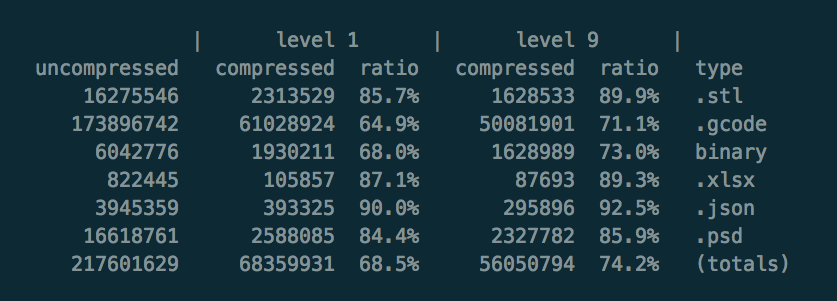
Equally y'all can run across we only get 2–3% better compression ratio with much, much longer compression times. (At this point I should either show you lot a chart with time/size comparison or, better still, you may cheque it yourself.)
To change compression level in pako, just pass a level pick similar this:
var compressed_file = pako.deflate(input_file, {level: one}); Now, that nosotros know how to do this, permit's check the upshot of the above actions.
Did Nosotros Really Brand Uploading Faster?
Well, yes nosotros did.

After testing this method for a while, nosotros've decided to utilise it in our app. In our example, we were uploading some 3D model data described with JSON. Before compressing, they sometimes grew to 5–6MB. For those files nosotros were able to reach 90% compression ratio, which means uploading just 0.6MB instead of 6MB. At present, with 6Mbps upload speed, customer volition simply look 0.8s for the upload to complete instead of 8. Compressing these files takes below 0.1s, so we've achieved shut to 10x speedup.
But you don't have to believe me. In the end I'm only some random guy from the Cyberspace.
Why Don't You lot See for Yourself?
I've prepared a small-scale demo app that you lot can use to come across whether or not this might be usable in your case. Merely select upload speed and add some files. The demo will have care of compressing it and simulating upload speed. Don't worry — it'due south non really sending your files anywhere, it'south merely moving the progress bars so you can compare time required to ship uncompressed and compressed data.
What Side by side?
There are a few more things to go on in mind. The most important is to recollect, that your server now receives compressed data, so if you need to piece of work with it, yous'll have to unpack it first. Unpacking is all the same way faster than packing, so information technology shouldn't be an event — specially considering how much extra time nosotros've gained.
Another thing to keep in heed is that compression is non instantaneous. It may take a few seconds for bigger files (for some huge 450MB files, you may need to wait about 30 seconds). Be nice to browsers. To go along your website from freezing, either procedure files in chunks (pako has a support for this), or endeavor throwing some Web Workers in there.
Well, that's simply it. What use practice y'all meet for this solution in your apps?

If you enjoyed this mail service, please don't forget to tap ❤! You tin also follow u.s. on Facebook, LinkedIn and Twitter.
Source: https://blog.daftcode.pl/how-to-make-uploading-10x-faster-f5b3f9cfcd52
0 Response to "Fast Way to Upload Media to Server"
Post a Comment